KZScott

Needs a life
high on speed
Posts: 7235
|
 posted December 30, 2008 10:03 AM
flow rates for jets
does anyone have a link to an online calculator or have a formula for calculating how much fuel(gas) a jet will flow based on orifice size and psi?(for a set duration of time)
thx
____________
01 ZX-12R 8.84 @ 156.3 no bars, DOT tires. Pump Gas, NA.... turbo 8.47 @ 164.
00 ZX-12R 8.62 @ 165.2 no bars, slicks, Pump Gas, 55 shot.... turbo 8.32 @173
00 ZX-12R Fastest NA Kawasaki in the world 1: 222.046 1.5: 226.390 Loring AFB
00 ZX-12R street turbo 1: 227.9 1.5: 234.1 Loring AFB
00 ZX-12R LSR turbo 1: 263.1 1.5: 266.5 Loring AFB Worlds fastest ZX-12R
CMG Racing RCC Turbos
  
|
flite leader
Zone Head
Posts: 651
|
 posted December 30, 2008 11:25 AM
 Edited By: flite leader on 30 Dec 2008 19:49 Edited By: flite leader on 30 Dec 2008 19:49
this is maybe what you want
http://roadstarclinic.com/content/view/61/96/
carb jets were never Rated for "psi"
& THE VENTURI VACCUUM COULD VARY GREATLY WITH CARB DESIGN
2 examples ................................................smoothbores vs flatslides
put them in a vertical pipette gravity flow
what you get would be closer to the flow rate
no less there is a tool called a "Numbered Drill set ]
NOT in eighths or sixteenths
NOT in tenths
that actually correspond to the hole diametres
the numbers are simply a reference in that keihin uses another scale
just to be different as i suspect weber did holley & carter
either way you are going to get close & them move richer or leaner
an old school move was when you need someting that wasnt made or available
take the jet or jets.........solder them & redrill with the numbered set
[again this cant be done with the usual set wood or metal set ]
if you were good & were close........use it
yet you would have NO idea what size it was
NOT a bad thing as long as your motor was running right
& you wrote down the number of the drill you used
the other thing is all the above makers of jets would Change
thread pitch on the jets.........that too not a big deal
they are BRASS
they will go in regardless of pitch w/o damage
if you just warm em up a little
if you have to call somebody
get in touch with SUDCO
____________
bend your mind.....
or break your ass...!!
|
KZScott
Needs a life
high on speed
Posts: 7235
|
posted December 30, 2008 01:00 PM
well the topic has a reply, but i cant see it, so it must have been flite. if he was rambiling on about something unrelated. i just wanted to clarify that im looking to check flow rates on jets in my wet nitrous system. I want to know how much gas it will use based on jet size, psi, and the amount of time im spraying
____________
01 ZX-12R 8.84 @ 156.3 no bars, DOT tires. Pump Gas, NA.... turbo 8.47 @ 164.
00 ZX-12R 8.62 @ 165.2 no bars, slicks, Pump Gas, 55 shot.... turbo 8.32 @173
00 ZX-12R Fastest NA Kawasaki in the world 1: 222.046 1.5: 226.390 Loring AFB
00 ZX-12R street turbo 1: 227.9 1.5: 234.1 Loring AFB
00 ZX-12R LSR turbo 1: 263.1 1.5: 266.5 Loring AFB Worlds fastest ZX-12R
CMG Racing RCC Turbos
|
entropy
Moderator
Posts: 8671
|
posted December 30, 2008 01:12 PM
Flite puked up a hairball about carburetors...
____________
This moderator uses moderation in moderation
|
flite leader
Zone Head
Posts: 651
|
posted December 30, 2008 01:15 PM
if you read his inquiry
he didnt say what type jets
air jets....... fuel jets....... carb jets
he didnt say..........................
did he
____________
bend your mind.....
or break your ass...!!
|
entropy
Moderator
Posts: 8671
|
posted December 30, 2008 01:23 PM
if you actually READ his threads instead of burping up hairballs on them, you'd know he has a fuel injected zx12 with a wet system.
You are REALLY a piece of work.
PLEASE admit you are fishing, PLEASE
____________
This moderator uses moderation in moderation
|
tcchin
Zone Head
Posts: 867
|
posted December 30, 2008 03:36 PM
Edited By: tcchin on 30 Dec 2008 23:42
Not to be a smartass, but I think Bernoulli has an equation or two about that. If you google Bernoulli or "orifice discharge", you might have some luck. It's a pretty common second-year engineering problem, but it's been 20 years since I've had to look at that textbook. The male human brain begins shrinking at the age of 20...!
|
whitehendrix

Zone Head
fails!
Posts: 757
|
posted December 30, 2008 05:01 PM
flite, stfu. my keihins on my 7-R are factory rated for 22 psi. twenty-two pounds-per-square-inch of air pressure. ok? look it up. keihin CVKs on a 2000 ZX7-R.
imagine that.. a psi rating.  (gasp!! i can run boost RIGHT INTO MY CARBS WITHOUT THEM LEAKING!! just ask terry kinzer, bill hahn, mark vanderwald, or any other turbobike builder/owner) (gasp!! i can run boost RIGHT INTO MY CARBS WITHOUT THEM LEAKING!! just ask terry kinzer, bill hahn, mark vanderwald, or any other turbobike builder/owner)
just as well, WTF ARE YOU TALKING ABOUT with no "numbered drill sets"??
obviously you've never done a bit of machining or precision drilling in your life. i guess theres no #70 drill bit to drill vacuum pistons out to crispen throttle response....
ANYWAY.
i have a bernoulli based equation here, but am not sure it applies, but at least you'll have it to calculate ram-air pressures if you want. 
P=V^2 / 57,600
where
p -pressure
v^2 -speed (mph) squared
57,600 -a constant
you'll find that typically, ram air pressures at 200mph are about .7psi..lol
scott, man i searched the "library" as well as the interwebz and can't find anything, then again i may not be using the correct key words.. i tried
this would be an awesome formula to add to the collection tho if someone finds it!!!
thers enough mad scientists here to get a solid response i think..lol
____________
Duct tape is the handyman's secret
weapon. The black is for formal
occasions. - ZRXDean
ill never own a busa unless
someone gives me one.... and then
ill sell it -KZScott
|
Y2KZX12R
Needs a job
CompetitionCNC.com
Posts: 3762
|
posted December 30, 2008 05:14 PM
quote:
Flite puked up a hairball about carburetors...
LOL
He's been told many times that KZ cant see his posts, so therefore he cant read them. Yet he replies as if he can. Very strange.
____________
Y2KZX12R
CompetitionCNC.com

|
KZScott
Needs a life
high on speed
Posts: 7235
|
posted December 30, 2008 05:14 PM
Tim, Whiteh, thx. i googled, but couldnt find much i could understand. I was hoping for a nice little calculator to input jet size, psi, and time and get a volume 
____________
01 ZX-12R 8.84 @ 156.3 no bars, DOT tires. Pump Gas, NA.... turbo 8.47 @ 164.
00 ZX-12R 8.62 @ 165.2 no bars, slicks, Pump Gas, 55 shot.... turbo 8.32 @173
00 ZX-12R Fastest NA Kawasaki in the world 1: 222.046 1.5: 226.390 Loring AFB
00 ZX-12R street turbo 1: 227.9 1.5: 234.1 Loring AFB
00 ZX-12R LSR turbo 1: 263.1 1.5: 266.5 Loring AFB Worlds fastest ZX-12R
CMG Racing RCC Turbos
|
whitehendrix
Zone Head
fails!
Posts: 757
|
posted December 30, 2008 05:20 PM
i'm sure its very basic, in all honesty.. probaby one of those "why didn't i think of that" forumlas.
to my knowledge (correct me if i'm mistake, please) gas is WAY thin (we KNOW its lighter than water).. supposedly so thin, i hear that if gasoline were to be used in a waterjet (without the abrasives) it would take 10 times LESS pressure to cut a similar material that water.. so, 10kpsi as opposed to (the typical) 60kpsi you see on big jets.
with that in mind, i'm certain someone has a "how much water will flow thru THIS hole at X PSI, at X.X PSI, at XX PSI at XX.X PSI" and so on..
i would surmise the value of the flow rate would differ if that water-based forumla were used on gasoline.
man.. got the gears turnin buddy!! haha.. i'm wondering if jet thickness would also affect it? i mean, theres really not enough length to induce a pressure drop, so i doubt it..
are you looking for CC/min or lb/hr or a similar unit?
____________
Duct tape is the handyman's secret
weapon. The black is for formal
occasions. - ZRXDean
ill never own a busa unless
someone gives me one.... and then
ill sell it -KZScott
|
rgeorge

Expert Class
Posts: 220
|
posted December 30, 2008 06:30 PM
The problem with using a formula from a fluid dynamics textbook is it will require a viscosity for the liquid. If you found that, then you would have do adjust for the radiused entry some jet manufacturers like to brag about. Its not worth trying to calculate.
You need to do a flow test!
Test the jets you have to get a baseline flow number. Then you can calculate the change expected from increasing pressure or orifice size.
|
rgeorge
Expert Class
Posts: 220
|
posted December 30, 2008 06:34 PM
Edited By: rgeorge on 31 Dec 2008 02:46
Its more useful to measure mass flow rate, not volumetric flow rate.
After you measure your fuel jets, do a mass flow test on your nitrous jets.
You should flow about 6oz of nitrous for 1oz gasoline.
I'll try to dig up some numbers from my jet testing.
|
KZScott
Needs a life
high on speed
Posts: 7235
|
posted December 30, 2008 07:21 PM
yes i plan on doing a flow test to back up predictions. i just want to get an idea first. eventually i want to test all my jets to make sure they are flowing evenly, and to make sure my secondary tank will be big enough for lsr on a big shot. i dont think the one i have now will be big enough for lsr, but should be fine for the 1/4
____________
01 ZX-12R 8.84 @ 156.3 no bars, DOT tires. Pump Gas, NA.... turbo 8.47 @ 164.
00 ZX-12R 8.62 @ 165.2 no bars, slicks, Pump Gas, 55 shot.... turbo 8.32 @173
00 ZX-12R Fastest NA Kawasaki in the world 1: 222.046 1.5: 226.390 Loring AFB
00 ZX-12R street turbo 1: 227.9 1.5: 234.1 Loring AFB
00 ZX-12R LSR turbo 1: 263.1 1.5: 266.5 Loring AFB Worlds fastest ZX-12R
CMG Racing RCC Turbos
|
2000redrocket

Pro
Posts: 1662
|
posted December 31, 2008 07:42 AM
did anyone look up holley carbs for flow? i know there is no psi behind the jet but i think with all the holley use for ever someware you may get a start.
it sucks for gas info it seams cause i have a dam chart for nozzle size vs pressure for a furnace. u would think a nos company would of given a psi vs flow of the pills for wet systems.
|
2000redrocket
Pro
Posts: 1662
|
posted December 31, 2008 07:44 AM
Edited By: 2000redrocket on 31 Dec 2008 15:46
this did not copy and past well i googled and got this . may help it is using 10 psi at the jet.
http://www.google.com/search?hl=en&q=nos+gas+jets+vs+psi+flow&aq=f&oq=
The following is a general guide! All engines and setups will vary a little from these settings for optimum performance. These settings should give a slightly “over rich” and "safe" starting point under most conditions. This slightly over rich setup is preferred for standard production cars although racers with modified engines and ignition timings may wish to tweak them later on.
Remember this is only a starting guide! If you want really BIG power boosts you may need to go slightly “richer” still (more fuel) than this or very occasionally leaner. With most healthy engines a small (20% to 30%) increase should be OK with standard ignition timing. If in doubt or it sounds “harsh” then retard it by a few degrees! Should sound smooth, and simply accelerate harder.
Actual power gains have been calculated from known constants and in practice, when dynamometer tested over many years have been extremely close to what is actually measured on a variety of different naturally aspirated vehicles. Turbo cars and bikes are an exception here since the actual power given is often far higher than expected, and turbo lag is all but completely eliminated. In all cases it is best to begin testing with smaller Nitrous & Fuel jets first and then listen carefully and check spark plugs as you go up to your desired bhp increase.
The GREEN fields represent the standard +25 bhp, +40 bhp, +50 bhp, +70 bhp, and +100 bhp systems
Nitrous Jet
Size
In Millimetres
1mm = 0.03936 inch Approx Power increase with 800 psi Nitrous Oxide pressure Fuel Jet (mm)
for a 3 BAR or 45 psi (above manifold) fuel injected Fuel Jet (mm) for a Separate fuel pump & regulator set to 10 psi pressure Fuel Jet (mm) for a fuel pump & regulator that also feeds carburettors at 3 psi Motorcycles that use gravity feed from tank
No Fuel pump needed Check! FLOW RATE - Disconnect the pipe from the injector, or from the distribution block (if used) and time how long it takes to fill a 1 Pint container with fuel. With Nitrous Bottle disconnected, and the engine is running, and the Fuel Solenoid energised. (+ / - 5%)
0.30 6.3 bhp Too small for reliability & practicality 0.30 0.40 - 1 pint fuel delivered 1031 seconds
0.35 8.6 bhp 0.35 0.50 - 1 pint fuel delivered 755 seconds
0.40 11.2 bhp 0.40 0.55 - 1 pint fuel delivered 580 seconds
0.45 14.2 bhp 0.300 0.45 0.60 - 1 pint fuel delivered 457 seconds
0.50 17.5 bhp 0.325 0.50 0.70 - 1 pint fuel delivered 317 seconds
0.55 21.2 bhp 0.350 0.55 0.75 - 1 pint fuel delivered 309 seconds
0.60 25.2 bhp 0.400 0.60 0.80 *1.50 1 pint fuel delivered 260 seconds
0.65 29.5 bhp 0.450 0.65 0.90 *1.70 1 pint fuel delivered 216 seconds
0.70 34.3 bhp 0.475 0.70 0.95 *1.90 1 pint fuel delivered 191 seconds
0.75 39.4 bhp 0.500 0.75 1.00 *2.10 1 pint fuel delivered 162 seconds
0.80 44.8 bhp 0.525 0.80 1.10 *2.10 / no jet 1 pint fuel delivered 144 seconds
0.85 50.6 bhp 0.550 0.85 1.15
For 40 bhp upwards a
pump is needed so follow RED jet sizing options
Or a pipe from a larger size fuel solenoid
to distribution block with a bigger internal bore than 2.5mm
could be used instead 1 pint fuel delivered 130 seconds
0.90 56.7 bhp 0.600 0.90 1.20 1 pint fuel delivered 114 seconds
0.95 63.2 bhp 0.625 0.95 1.30 1 pint fuel delivered 103 seconds
1.00 70.0 bhp 0.675 1.00 1.35 1 pint fuel delivered 92 seconds
1.05 77.1 bhp 0.700 1.05 1.40 1 pint fuel delivered 84 seconds
1.10 84.7 bhp 0.725 1.10 1.50 1 pint fuel delivered 77 seconds
1.15 92.5 bhp 0.775 1.15 1.55 1 pint fuel delivered 71 seconds
1.20 100.2 bhp 0.800 1.20 1.60 1 pint fuel delivered 65 seconds
1.25 109.3 bhp 0.825 1.25 1.70 1 pint fuel delivered 59 seconds
1.30 118.3 bhp 0.875 1.30 1.75 1 pint fuel delivered 55 seconds
1.35 127.5 bhp 0.900 1.35 1.80 1 pint fuel delivered 51 seconds
1.40 137.4 bhp 0.950 1.40 1.90 1 pint fuel delivered 47 seconds
1.50 157.5 bhp 1.000 1.50 2.00 1 pint fuel delivered 41 seconds
1.60 179.2 bhp 1.075 1.60 2.15 1 pint fuel delivered 36 seconds
1.70 202.3 bhp 1.150 1.70 2.30 1 pint fuel delivered 32 seconds
1.80 226.8 bhp 1.200 1.80
Larger Solenoid 1 pint fuel delivered 29 seconds
1.90 252.7 bhp 1.275 1.90 1 pint fuel delivered 26 seconds
2.00 280.0 bhp 1.350 2.00 1 pint fuel delivered 23 seconds
*Bikes do not necessarily require a pump or a pressure regulator. The “weight” or head of fuel sat in the tank (provided it is above the injection point) and the inlet tracts “low pressure” ensures a reliable flow. The precise amount of flow varies, but these jet sizes generally give a safe and rich mixture. In the case of 2.10 mm fuel jet, no fuel jet is really needed because the actual diameter of the 4mm OD nylon tubing is 2.1mm inside the olive once tightened up and this restriction gives the same or very slightly more fuel flow, as the jet would have done. In some cases without a fuel jet on gravity fed systems, a better final setting will be to fit the next nitrous jet higher, (45 bhp 0.80 mm) instead to give the required mixture. Disregard the fuel delivery rate column here, as this applies only to pumped systems. Before you try this 0.8 mm jet make sure it is running rich enough with the 0.75 mm Nitrous jet first.
Power for any given Nitrous jet:
Nitrous Oxide Jet’s bore, in mm squared x the constant 70 = Power increase in bhp at 800 psi Nitrous bottle pressure
Fuel jet Calculations:
At 45 psi - Jet size mm squared x 157 = correct fuel for x power (Nitrous jet diameter in mm minus 33%)
At 10 psi - Jet size mm squared x 70 = correct fuel for x power (Nitrous jet size = Fuel Jet size)
At 3 psi - Jet size mm squared x 38.4 = correct fuel for x power (Nitrous jet plus 35% in mm diameter)
Formula for “time” (T) in seconds to deliver 1 pint of fuel for a given horsepower rating:
T = (the constant) 6500 divided by “Horsepower” or… T = 6500/P (Where P is Power)
|
VincentHill

Needs a life
Posts: 6520
|
posted December 31, 2008 08:00 AM
KZ, this is how I blew up my bike! I did all of my own flow testing and wrote the results and had my own chart to set the fuel pressure and NOS Pressure for the exact HP Amount I wanted to use. I also tested the setting on a dyno with a Sniffer and my Data Logging to make sure they were safe!
Then the Idiot Owner of the bike (Me) first forgot to turn on the NOS Arming system and made a few runs and then realized what he had done and then armed the system and upped the NOS Pressure but FORGOT to up the fuel pressure!
No one to blame here other than the Owner! ..It took many days and hours of flow testing of the fuel and NOS (Weighing the Bottles after each and every test to get the data I needed to make 75, 100, 125, 150, 175 and 200 HP Set Ups for the NOS. That is only 6 settings for the fuel and NOS. That is the NOTE I am going to "PAINT:" on the bike to make sure I follow my own instructions! 
____________
Made History @ Daytona and still one fast old man!!
|
KZScott
Needs a life
high on speed
Posts: 7235
|
posted December 31, 2008 08:59 AM
Edited By: KZScott on 31 Dec 2008 17:01
thx RRocket
VH i only want one setting, so once its set and verified to be the correct AFR its staying that way!! Im going to run equal jetting, eight 28 pills and start with about 12 psi on the fuel (950 on the nitrous) to make sure its rich then tune it a bit leaner. my uncles vette runs equal jetting with 9psi on the fuel on his fogger system so 12psi should make my setup pretty fat and safe for initial testing IMO
do you have any recommendations on what to buy for flow testing? i have an idea of what i need but havent looked into it that heavy yet. i may have what i need allready
____________
01 ZX-12R 8.84 @ 156.3 no bars, DOT tires. Pump Gas, NA.... turbo 8.47 @ 164.
00 ZX-12R 8.62 @ 165.2 no bars, slicks, Pump Gas, 55 shot.... turbo 8.32 @173
00 ZX-12R Fastest NA Kawasaki in the world 1: 222.046 1.5: 226.390 Loring AFB
00 ZX-12R street turbo 1: 227.9 1.5: 234.1 Loring AFB
00 ZX-12R LSR turbo 1: 263.1 1.5: 266.5 Loring AFB Worlds fastest ZX-12R
CMG Racing RCC Turbos
|
rgeorge
Expert Class
Posts: 220
|
posted January 04, 2009 11:17 PM
quote:
i have an idea of what i need but havent looked into it that heavy yet. i may have what i need allready
You should use a good quality scale and and four Erlenmeyer flasks.
I used a postage scale and four empty bottles from a Flying Dog Brewery sampler pack.
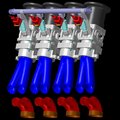
You will also need a stopwatch, temporary switches to activate the fuel pump and solenoids, a gauge to monitor fuel pressure, and a long fuel line to reach from the bike to the test bench. It takes a while, so keeping a battery charger hooked to the bike during the test would probably be a good idea.
I tested the fuel jets first. In the pic below, the nitrous line is not connected to the solenoid. The fuel solenoid is out of view (still on the bike)
I have rigid SS lines with the two inner nozzles angling inward, so getting them to spray into the bottles without loosing any fuel was tricky.
Do a couple of practice squirts to make sure you aren't loosing any fuel and to get the air out out the lines.
Empty the bottles and make sure they all have the same zero on the scale.
The fuel flow from the nozzles is not very spectacular. The nozzles use the 900psi blast of nitrous to atomize the fuel.
Do a long test, fill the bottles as much as you can without risk of spillage.
Record the fuel pressure during the test and the elapsed time.
Weigh the bottles. There should be less than 2% variation between them. If there is variation, find the cause.
I did a quick test with my nitrous jets installed on the fuel side of the nozzles. I didn't record the time, I just went long enough to determine that those jets flowed equally.
Now to test the nitrous side. You wont need the collection bottles for this test.
Install the nitrous jets on the nitrous side of the nozzle. Connect the lines and the nitrous bottle. Purge the air from the system then record the bottle weight (while still connected). You'll want a long, flexible line to the bottle that wont interfere with accurately weighing the bottle.
Do a short blast and record the time and weight lost from the bottle. Multiply to find the amount of nitrous that would have been used if the test were as long as the fuel test.
Calculate nitrous to fuel ratio.
Adjust fuel pressure or jet sizes to get the proper ratio.


|
VincentHill
Needs a life
Posts: 6520
|
posted January 05, 2009 01:36 AM
Close to what I Used! I used a graduated plastic Mix Rite cup and a Digital Scale
____________
Made History @ Daytona and still one fast old man!!
|
entropy
Moderator
Posts: 8671
|
posted January 05, 2009 01:52 AM
Rob,
VERY cool experiments!!!!!
____________
This moderator uses moderation in moderation
|
KZScott
Needs a life
high on speed
Posts: 7235
|
posted January 05, 2009 09:19 AM
thx guys, very helpful!
____________
01 ZX-12R 8.84 @ 156.3 no bars, DOT tires. Pump Gas, NA.... turbo 8.47 @ 164.
00 ZX-12R 8.62 @ 165.2 no bars, slicks, Pump Gas, 55 shot.... turbo 8.32 @173
00 ZX-12R Fastest NA Kawasaki in the world 1: 222.046 1.5: 226.390 Loring AFB
00 ZX-12R street turbo 1: 227.9 1.5: 234.1 Loring AFB
00 ZX-12R LSR turbo 1: 263.1 1.5: 266.5 Loring AFB Worlds fastest ZX-12R
CMG Racing RCC Turbos
|
dougmeyer

Needs a job
moderated
Posts: 2713
|
posted January 05, 2009 08:25 PM
Edited By: dougmeyer on 6 Jan 2009 04:26
OK this topic is WAY too deep for me to to get into right now, but I skimmed it and I'll give you a few nuggets to stir the pot. Kind of in a flite leader format and in no particular order.....
Yes, you need to know the what fluid you're trying to flow, the same size orifice will flow different mass flows at a given pressure and temperature, depending on current specific gravity and viscosity.
No pressure behind the jet in a Holley, RR? What about the delta between the atmospheric and the depression (vacuum) in the venturi? Is this not what moves the fluid through the jet? Think man!
It takes 4 times the pressure to double the flow through a given orifice.
Jet flows change by the change in area, not diameter. An .080 dia orifice does not flow 2 times that of an .040 orifice, it flows 3.999 times as much.
You CANNOT simply drill a jet and expect some proportional increase in flow through that jet (even if you do use one of them new fangled number drills). This is because all properly designed jets use approach angles and/or radiuses to smooth the flow into and out of the critical diameter. When you drill a jet you destroy the designed flow and it would not be unheard of for (fill in the name of your favorite doofus) to drill a jet and actually end up with LESS flow. Try and tune your way out of that and remain sane.
A given flow through an orifice always depends on pressure and TIME. Remember that if you don't have much time.
The ONLY way to determine the right sizes of these components is real world testing and accurate data.
rgeorge knows pretty much exactly what he's doing.
That's all that comes to mind right now.......
Doug
____________
It's not that I think you're dumb, it's just that so much of what you know isn't true....
|
KZScott
Needs a life
high on speed
Posts: 7235
|
posted January 06, 2009 09:58 AM
Hey Doug, FL format or not at least you use complete sentences we can understand! 
thx for stirring the pot
____________
01 ZX-12R 8.84 @ 156.3 no bars, DOT tires. Pump Gas, NA.... turbo 8.47 @ 164.
00 ZX-12R 8.62 @ 165.2 no bars, slicks, Pump Gas, 55 shot.... turbo 8.32 @173
00 ZX-12R Fastest NA Kawasaki in the world 1: 222.046 1.5: 226.390 Loring AFB
00 ZX-12R street turbo 1: 227.9 1.5: 234.1 Loring AFB
00 ZX-12R LSR turbo 1: 263.1 1.5: 266.5 Loring AFB Worlds fastest ZX-12R
CMG Racing RCC Turbos
|
|
|

 HOME
HOME NEW TOPIC