lietoome

Needs a job
Posts: 2033
|
 posted August 08, 2005 01:21 PM
capacitor for a zx12
can a capacitor be hooked up on a zx12? My insrument panel dims in and out when I have my blinkers on. I plan on adding some more 12volt accessories(radar, nos controller, lights, and a cigarette lighter((so I can ride and smoke...J/K)) and was curious if it would work. I'm not real familiar with motorcycle charging system, so any help is greatly appreciated. I'm guessing the kind for car amplifiers might work, 1 farad capacitor?
thanks--
jeff
  
|
frEEk

Administrator
ummm... yeah
Posts: 9660
|
posted August 08, 2005 02:23 PM
it should work indeed. i actually saw an article or product description yesterday about replacing a battery altogether with a capacitor for motocross bikes. don't know that such a large capacitor would be necessary, as the big sound systems that use them are gonna pull WAY more power than what you will be using. also, i'm pretty sure that's 1microfarad. i'd tend to go with one of the half height (4" about?) .5microfarad units at most. of course a cap won't help you deliver more power, just smooth out the surges.

|
trenace

Needs a job
Posts: 3056
|
posted August 08, 2005 02:40 PM
 Edited By: trenace on 8 Aug 2005 17:18 Edited By: trenace on 8 Aug 2005 17:18
A capacitor does store a (relatively) small amount of energy and as a result can smooth brief voltage fluctuations.
As frEEK said, it's possible to run some bikes with only a capacitor and no battery, assuming their stator requires no initial voltage to get going.
A pretty large capacitor is required: TrailTech sells a 56,000 microfarad capacitor for this purpose.
1 farad would be a million microfarads so that would be a lot larger yet. It should definitely have some major smoothing capacity. As frEEK says, probably more than necessary -- but I'd disagree that 5 micofarads would be enough.
However, only in the sense of being able to fill in voltage dips lasting very briefly and on the assumption that the charging system is powerful enough to make that up.
I have never noticed my instrument panel dimming from the blinkers (never checked for that though) and that just does not sound right. I would think the battery must be horrible for that to be happening, and I'd wonder why the stator is not supplying enough current to be able to support that very small load. Either that, or perhaps the instrument panel draws power from the same wire that the blinkers do, and there is a resistance in this wire, causing that wire alone to drop in voltage while the rest of the bike is OK.
A capacitor will not enable the electrical system to support more ongoing load than the stator puts out... if even the blinkers are currently actually overloading your stator and battery (which may not be the case, perhaps it is just resistance in one circuit as said above) a capacitor will do nothing to help being able to handle higher ongoing loads such as brigher lights or the other accessories you are considering.
|
Wideout

Expert Class
Posts: 300
|
posted August 08, 2005 04:06 PM
gd nice post.
|
frEEk
Administrator
ummm... yeah
Posts: 9660
|
posted August 08, 2005 04:17 PM
oops, my bad on the capacitor rating. the big audio ones are indeed 1F, judging by what they claim at least. that's just an insane amount of capacitance.
|
lietoome
Needs a job
Posts: 2033
|
posted August 08, 2005 05:37 PM
thanks guys. I'm guessing the more compact .5 f capacitor will do. I realize it wont give me more power, but just to maintain a smooth transition when blinker is on and brakes are applies.
Trenance, good to hear from you. The panal is only the extreme -- high beams, blinker, brake lights...but I am considering using a 12v accessory, running lights/blinkers, radar, and the nos controller. I am fully aware that the amp draw from these is minimal, but I want all to be covered in any case.
thanks for the input guys.
jeff
|
trenace
Needs a job
Posts: 3056
|
posted August 08, 2005 07:10 PM
Edited By: trenace on 8 Aug 2005 20:12
Hey Jeff, glad to see you here (saying that belatedly.)
BTW I checked tonight and my instrument panel isn't affected by the blinkers. Nor by switching to high beam.
I am not dead positive but -- looking at an A model manual as Kawasaki sent me the wrong one for my bike -- it does look to me from the master wiring diagram that the instrument lights get their power from the same source as the handlebar switches.
So, my guess is your problem is NOT in the electrical system being so weak as to suffer voltage drops from the turn signal lights, but that circuit alone suffering the drops.
This may be due to a bad connection.
It should not be happening.
Putting a capacitor across the entire system -- e.g. from the battery positive to battery negative -- would not fix this then.
Possibly putting it into that one circuit would, or perhaps a poor connection can be found and corrected.
A test could be to apply some other extra load to the main power, in other words directly off the hot lead of the battery. If you can switch on some bright external 12 volt light and that does NOT dim the instrument panel, then this would prove that extra current drain per se is not the problem, but only extra current drain within that one circuit that powers the instrument panel lights and the indicator switches.
|
lietoome
Needs a job
Posts: 2033
|
posted August 09, 2005 02:08 PM
Damn good thought Tren. I will have the plastics off next week, and see exactly what it is thats going on.
thanks--jeff
|
VincentHill

Needs a life
Posts: 6520
|
posted August 11, 2005 08:02 AM
What are you guys doing talking about Capacitors? In the "Olden" Days, we used a Large Can style as a Battery Eliminator and the Triumph Dealers sold them. Worked great eacept slow speeds.
____________
Made History @ Daytona and still one fast old man!!
|
lietoome
Needs a job
Posts: 2033
|
posted August 11, 2005 06:31 PM
VH, you're showing your age...LOL.
I did see some made specifically for harleys, wasn't sure exactly what they were though.
|
trenace
Needs a job
Posts: 3056
|
posted August 18, 2005 03:35 PM
Edited By: trenace on 20 Aug 2005 23:59
L2M, on account of your having mentioned 1 farad capacitors and the fact that I'll be relying on only the stator and a very small NiCd pack for the main electrical system (and with a separate LiPolymer batter pack for the starter) I ordered one of these bad boys.
I had been planning on using one that was about 56 microfarads but it seemed, why not have more juice, so as to better supply any peak draws from the fuel injection or ignition.
Cost about $50.
Well, the thing arrived... from the pictures I'd assumed it was small, but it is HUGE! I will not be able to use this. It is over 4 lb and maybe about 10" long and 3" thick as guesses.
If anyone wants one of these and is willing to pay for shipping -- it's intended for car audio systems -- let me know, $10 and it will be theirs, no reason for it to go to waste!
UPDATE: Taken! 
|
frEEk
Administrator
ummm... yeah
Posts: 9660
|
posted August 18, 2005 06:01 PM
the .5 farad ones are, not surprisingly, about half as tall. that may fit the bill very well.
|
trenace
Needs a job
Posts: 3056
|
posted August 18, 2005 06:11 PM
Edited By: trenace on 18 Aug 2005 22:46
Yes, I think I will buy something between 0.1 and 0.5 farad. If the weight per amount of capacitance is roughly constant, then the 0.1 farad one could weigh about 0.4 lb, or 0.25 farad could weigh about 1lb, which is more than I wanted the capacitor to weigh but I am starting to seriously doubt whether the 56 microfarad capacitor is good enough.
The company or individual that sold it to me (an eBay outfit) specified it as being for a ZX-12R but I really have no info that it was adequately, if at all, tested.
However, even if the capacitor weighs one lb, I'm still pretty well ahead, with total weight of about 3.25 lb (1.5 lb LiPoly pack, 3/4 lb NiCd pack, 1 lb capacitor.)
Of course that's getting pretty close to a YTZ7A, which weighs 4.7 lb. So if the 7A will crank a ZX-12R, then this whole thing has been an exercise in stupidity... but if it will not, then I'll have saved a lot of weight compared to stock battery.
Given the troubles some have had with 1290's and the stock battery, I was assuming a YTZ7A, with 140 CCA, probably doesn't have the cranking capacity I'd need.
Anyway, on the capacitor, what I'll do is install the 56 (or somewhere around there) microfarad capacitor and all the rest of this battery system, and if it works fine, then use maybe an 0.1 farad capacitor for extra margin in case of imperceptible performance losses with the smaller capacitor.
|
frEEk
Administrator
ummm... yeah
Posts: 9660
|
posted August 18, 2005 09:58 PM
trenance, u'r not trying to start a 12R with a small pattery pack (non-automotive) and a cap are u?
|
trenace
Needs a job
Posts: 3056
|
posted August 18, 2005 10:15 PM
Edited By: trenace on 18 Aug 2005 23:21
The LiPoly pack comprises 8 subpacks, each of which is rated for up to 24 amps for short duration -- and that duration I expect is much longer than what's involved in starting -- and so the total should be good for 196 amps. No capacitor is planned for that part of the system.
It will be isolated from the rest of the electrical system (other than common ground) and used ONLY for the starter. The reason for this is that LiPoly batteries cannot, or cannot readily, be recharged safely on or in a vehicle. I will be recharging them from an external charger when stopped.
The rest of the electrical system though will be depending on the stator for ongoing "juice," with a supplemental really small NiCd pack and the capacitor to "smooth" the peaks and to fill instantaneous brief high demands.
That is the plan anyway.
For sure no ordinary small battery pack could do the starter. This specific LiPoly deal is pretty unique: most LiPoly batteriesof that total weight or anywhere near it could not remotely put out that amperage.
Generally speaking, with this rare exception, "more advanced" battery types don't deliver better, if even as much, amperage per lb as good lead acid batteries. So generaly speaking, nope this can't be done, but the particular batteries I'm using I think are an exception due to their outstandingly high amperage rating per small pack.
|
frEEk
Administrator
ummm... yeah
Posts: 9660
|
posted August 19, 2005 09:28 AM
hm, very interesting, keep us posted. i certainly don't see a problem runnign the bike of a cap once it's going, but i'd be worried about the ability of your battery to start the bike. seem s to me having to plug it in whenever u get home is rather annoying, tho not too bad. however, what do u do when u go out and have to make a few stops? or on a longer trip?
|
trenace
Needs a job
Posts: 3056
|
posted August 19, 2005 12:01 PM
Edited By: trenace on 19 Aug 2005 13:08
It has enough energy storage to be good for an estimated 40 starts. So even if my estimation is off by a fair bit I should still be OK.
If I took an overnight trip, I could bring the charger with me (it's REALLY small, not much bigger than a pack of cigarettes) and recharge the bike in a motel room I figure.
What the issue on recharging is, is that with lead acid and NiCd batteries, if you have them in series to achieve a greater total voltage, recharging them in series works safely. There is no tendency for one cell in the series to get overcharged while others get undercharged. Apparently though with the LiPoly, applying the correct total voltage across the series of cells does NOT guarantee that no individual cell will "see" too much voltage across it.
So, you're supposed to periodically monitor each "tier" of the battery pack to make sure it's within 0.1 volts of the others, and if necessary charge tiers separately so as to achieve that.
This actually COULD be done on the bike but would be kind of a rig: inverting the stator's 14 volt supply to 110 AC, then having four individual LiPoly chargers to charge each individual tier of the pack. I haven't added up the weights of that but it would be at least a pound, maybe two pounds, and would kind of be a rig in my view and I just didn't want to do that. Recharging when stopped seemed practical enough.
I will post how the system works, once I have it going which should be soon. I have the battery pack together except for the leads for testing or charging two of the mid-voltage-tiers, and the capacitor.
On a dollar-per-lb-saved basis, actually it's cheaper than a lot of other weight saving mods, BUT, there is the disadvantage that the batteries will have to be replaced periodically. If they last 2 years it's not that bad, if it's annually it would be pretty bad.
|
frEEk
Administrator
ummm... yeah
Posts: 9660
|
posted August 19, 2005 12:51 PM
damn, 40 starts frmo a little lipoly battery pack? what is the mass & volume? pretty cool stuff if it works.any idea how reliability will be? desistance to all teh vibrations & jarring of the bike?
|
trenace
Needs a job
Posts: 3056
|
posted August 19, 2005 01:19 PM
Edited By: trenace on 19 Aug 2005 14:29
Total weight should be 1.5 lb from the LiPoly pack for the starter (another 9 ounces I think for the NiCd for the rest of the electrical system, plus something for the capacitor.) They fit nicely into the battery tray, by good luck an interference fit along with the NiCd in terms of length, and I'll cut some styrofoam or something to take up the 1/4 inch or whatever excess on each side.
I don't know why they shouldn't be perfectly reliable.
I don't know about vibration resistance. I'll see if I can fit some Sorbothane "feet" on the battery tray to give it a little isolation, but the Twelve doesn't vibrate that badly. That certainly is a potential point though, and has been an argument against "advanced" battery types.
However LiPoly is a more "solid" sort of construction I think than regular lithium-ion batteries. There's not really oozy liquid so to speak inside them, if I understand correctly, so perhaps that should help.
Here's a pic of a single of what I guess I'd have to call a sub-subpack within my pack, namely two cells (which wind up being put in series with another two cells to yield a subpack, and then eight subpacks in parallel yield the full pack):
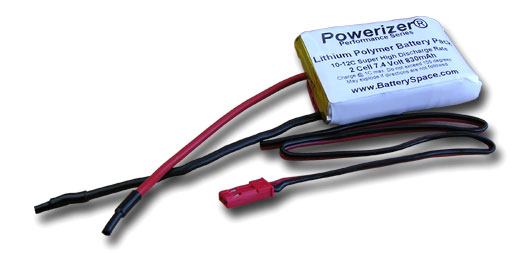
That little cord, incidentally, is so as to be able to charge cells individually. Or in my case, they'll be tied together, so I can charge each "tier" of the pack individually.
The pic is approximately life-size, if viewing the board on a 17" monitor. The dimensions are 1.5" by 2" by 0.5" and the weight is 1.5 ounces.
The 830 mAH storage capacity means 6.6 amp-hours with the 8 subpacks in parallel. It's purely a guess on my part that that should be enough for 40 starts, though I made the guess based on estimates of cranking time and amperage drawn and calculating from that.
|
frEEk
Administrator
ummm... yeah
Posts: 9660
|
posted August 19, 2005 02:06 PM
definitely a significant weight savings.
i think u'r stretching it with 40starts, but i guess that depends just how easily it starts up. i take it u are stock displacement & compression? i've yet to test how many starts u coudl get frmoa non-recharged stock 14Ah battery, but at about 1/17th the storage, i'm thinking u'r closer to 10 starts. still, that should be plenty for normal use.
for charging the pack, can u not just wire the charger in parallel over each cell? can u do so straight from the bike's electrical system or does the charger have to be smart? be nice if this could be done so u can lose the extra running batter (& prolly the cap) plus not ahve the home-recharging issue.
hm, see some of my questions are answered on the powerizer site. looks liek it requires a smart charger, plus u cant get 12V from teh system so it wouldnt work to power the bike other than the starter. and i didnt realize it was 830mAh EACH. i'd be tempted to use the 1.450mAh model but may not have enough amperage then, as i don't know what the capability of 2 pairs of 2 of these models is.
anyway, good for u for experimenting. looking forward to read the results.
|
trenace
Needs a job
Posts: 3056
|
posted August 20, 2005 09:17 PM
Edited By: trenace on 20 Aug 2005 23:59
It's running!
No test ride yet but I just fired it up in the garage (having gotten to a ready-to-test point only just now..) Whatever concerns I'd had about it possibly not cranking hard enough are gone... actually the pitch sounds much higher and faster, very fast cranking indeed. I should think it will easily handle the 1290 when that's done.
Basically the stock wiring has the same "hot" going into the hot of the starter relay as going to everywhere else in the bike, but this can be separated out into one very heavy duty wire that goes from the hot to the starter relay; and then a medium gauge wire that ordinarily connects right to the battery terminal and also a medium gauge wire that comes off of a plug in back of the starter relay. The difference here is that now those latter two "hots" are off of a little NiCd (with a capacitor across it as well), while the starter "hot" is off the of the LiPoly, thus isolating the systems so far as charging and draining.
First ride with it tomorrow! About 7 lb saved!
|
trenace
Needs a job
Posts: 3056
|
posted August 21, 2005 04:22 PM
Edited By: trenace on 22 Aug 2005 02:37
The LiPoly worked great today. I haven't kept count (which is dumb) but I must have about 15 starts on the pack now still on the original charge, and it's still spinning the motor like a champ. It still has 16.9 volts, so still definitely kickin'.
The small capacitor I'm presently using appears inadequate in capacity, as the neutral and high-beam indicator lights flicker at idle. The 0.1 farad capacitor on order as a guess will have 10-20 times the capacity and so should fix that.
The ride went fine, including stopping for gas and restarting. But on getting back, I restarted the engine, idled it for about a minute or two, and then when I tried another restart I saw the lights in the instrument panel were dim and there was (apparently) a relay up there clicking away. It tests at 11.9 volts (it had been about 15 volts, forget what exactly, when fully charged. The 12's operating voltage is not, by the way 12 volts but rather ranging from 14.2 volts at low rpm to 15.2 volts at higher rpm, or so saith the book anyway.)
So it seems that the NiCd has relatively little capacity and also must be discharging under such idling conditions rather than recharging or at least maintaining charge. A few possible solutions to that:
1) Don't have high-beams on when idling,
2) Increase idle back up to factory spec -- I have the idle down around 650-750 for the stupid reason of liking how it sounds at that speed and the oil pressure apparently still being OK at that speed,
3) Convert over to HID lights drawing only 26 watts total now instead of later -- big savings in current,
4) Take the parking light bulb out or replace with LED equivalent, if there is one that conveniently fits that,
5) Put in that LED taillight that I hadn't put in yet.
Then on top of that, I could add in an "emergency backup" switch that would let the LiPoly pack power the main systems as well (temporarily, until the engine is running) so as to be able to start the bike in event of the NiCd pack dying on me. Or, I could have the switch and then not even need the NiCd pack, saving another half pound. That may be the way to go, actually, provided voltage from the stator and voltage regulator (with added capacitor but no battery) is okay for the ECU at idle, and provided that 16.9 volts from the LiPoly pack would not be too much for the ECU or Power Commander.
|
frEEk
Administrator
ummm... yeah
Posts: 9660
|
posted August 22, 2005 11:50 AM
i'd be wary of running the system at 17V too. plus i'd be concerned about the effects of the system attempting to charge the lipoly battery in that instance too. i'd think jsut raising the idle is liekly the simplest solution. that in combination with the bigger cap may even be good enough to dump the nicd cell entirely i'm thinking.
|
trenace
Needs a job
Posts: 3056
|
posted August 22, 2005 01:22 PM
Edited By: trenace on 22 Aug 2005 14:28
Oh, the system wouldn't be running at 17 volts except for that instant of starting, at which point I'd flick the switch back off and then the mains would be running entirely off the stator, with the capacitor to smooth.
As you say I definitely don't want the voltage re-regulated to 17, nor the mains attempting to charge the LiPoly (or the mains being able to drain down the LiPoly: so it's got to be disconnected when the motor's up and running.)
One thing I could do would be to find what resistance between the LiPoly and the "mains" will result in say a 2 volt voltage drop across it when the key is turned on. That would probably be somewhere around 1 or 2 ohms I guess. The only slightly kludgy thing would be needing to activate a switch right before starting and then turning it off right after starting. (This switch would only affect the LiPoly's connections to the "mains," not its connection to the starter relay. It would not need to handle much current so I probably don't need a relay, though one could be used.)
That may not be too bad a way to go -- perhaps this is the solution and I should just ditch the NiCd.
I am also thinking that maybe the NiCd could have lost "juice" from heat soak. NiCd's are pretty sensitive to that. LiPoly's fortunately are a lot more tolerant, but even so installing a tiny exhaust fan in the battery box, so as to exhaust air from that part of the frame, might not be a bad thing. I could just use a thermometer though and see how bad the heat soak gets before doing that, though.
|
frEEk
Administrator
ummm... yeah
Posts: 9660
|
posted August 22, 2005 04:39 PM
btw, i forgot to say congrats on gettin it workin and the successful test ride! so often these things never end up flyin, so good on u for seein it thru. u have significant experience with electronics i take it?
|
|
|
|
|

 HOME
HOME NEW TOPIC