We've had a number of motorcyclist fatalities in our little town, and I suspect that it's the same story all across America. I'm sad for the families of the deceased riders, but I'm angry that so many motorcyclists put themselves in danger. The prevailing attitudes among motorcyclists seem to be that "anyone can do it," and "no special skills are needed." People who are otherwise prudent about life seem willing to hop on a motorcycle and zoom off into traffic with almost no practice or study.
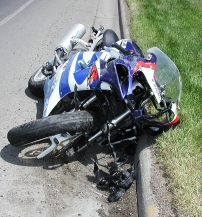
Our latest victim was an off-duty police officer who was riding with some friends on a Sunday afternoon. She was 27 years old, popular, and at the prime of her career. According to the State Patrol, her motorcycle "failed to negotiate a right curve." "The motorcycle crossed the centerline and struck the right front bumper of a southbound pickup truck that was towing a boat trailer...the rider was pronounced dead at the scene." The news article notes that her bike was a 2004 Yamaha, but says nothing about her licensing status or experience level.
Later in the week, headlines read: "Police bid a solemn farewell." A procession of about 50 police and emergency vehicles delivered the flag-draped coffin to the high school auditorium for a memorial service where hundreds of mourners honored her memory.
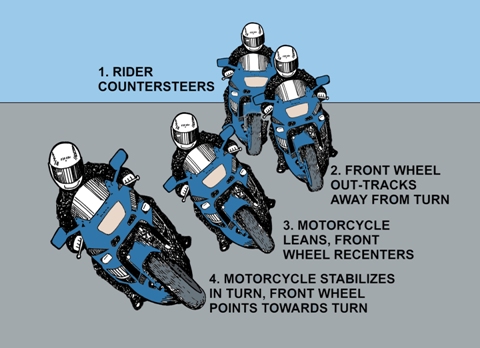
I'm sure that no one in our community would want to hear that she might have done it to herself, but in the case of many self-inflicted fatalities that's the sad truth. Her friends all made the cornershe didn't. A motorcycle going wide in a turn is an indication the rider didn't know how to corner. And since the bike was less than a year old, we know that she hadn't had much experience with that machineand we might suspect she hadn't been motorcycling very long. It's entirely possible she had never learned to countersteer, or had heard about it but never gotten it between her ears.
Did her friends know she was inexperienced, but assumed that she would absorb the necessary skills by just getting out and riding? Did any of her riding buddies explain cornering techniques to her, or suggest taking a training course, or loan her copies of books that might have expanded her knowledge and skill? We don't know. The tears are flowing now that she's dead, but apparently there wasn't enough concern when she was still alive and struggling to figure out how to control her motorcycle.
Illustration: Do those new riders understand basic control skills such as countersteering? Show 'em a picture. Loan 'em a book.
Just yesterday I was driving my SUV out of the hardware store parking lot. The lot is two lanes in at the east end, and two lanes out at the west end. It's a two-lane street with a center turn lane. At the exit, I observed a motorcycle approaching from the west, but the rider gave no indication he might be turning. Then as I started to pull out, he suddenly darted into the center turn lane, and leaned into a left turn. Halfway into the street, I braked to a stop. He circled around in front of me and rode into the exit. No signal, no braking, no concern that a collision with a 4,000 lb truck might hurt. And no acknowledgment that he was going the wrong way or that I had braked to avoid hitting him.
I bring up this example of "asking for it" because the world is full of drivers who are not concerned about motorcycles, and therefore motorcycles do not register on their mental radar. This rider could just as easily have turned in front of an inattentive driver, and the impact could have been fatal. And of course the following week there could have been another memorial service with tears and quavering speeches about how he loved motorcycles, and what a great father he had been.
When I first started riding, I felt that motorcyclists who crashed were victims of something out of their control. With more experience, I realized that many riders did it to themselves. One day I was in line for the signal light, waiting to pull out onto the main highway. A rider in street clothes zipped by me on the wrong side of the road, and attempted to carve off on a side road, oblivious to the white lines being covered in dew. His tires slid out, the bike low-sided, and he slid along for a few feet sanding off bits of shoes and clothing. Fortunately, it was a slow-speed crash.
The surprised rider picked himself up with a shocked expression, staring at his bloody palms. I didn't stop to assist, I just motored on when the light turned green. I wouldn't have been sympathetic. I'd probably have said, "who do you think you are, superman? If you aren't hurt, I'll give you a couple of healthy kicks in the ass with my steel-toe boot to further your education."
Stupid Riding Ticks Me Off
What angers me about stupid riding is that it's unnecessary. Why risk your life riding on public roads before you learn how to corner? Why risk your life just to get into a parking lot a few seconds sooner? I suppose the answers include motorcyclists not knowing how to control a motorcycle proficiently, not understanding what danger looks like, or just not being aware that motorcycles require considerable knowledge and skill.
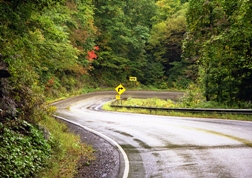
Photo: When inexperienced riders join your group, don't assume they know how to handle corners like this slippery, downhill right-hander. Take the new riders aside and offer some skills tips. Or, loan them a copy of a good skills book. If you don't help them, who will?
Back up again to that left-turning motorcyclist at the hardware store. His riding tactics really sucked. He didn't help the situation by sudden moves without signaling, or riding into an exit rather than going down to the marked entrance. More importantly, he didn't seem to recognize that SUVs are much more hazardous to motorcyclists than are smaller vehicles. If you slam into the side of a Civic or Corolla, the thin metal will absorb a lot of energy as it crumples, and you'll probably go sailing over the top to slide down the pavement. But if you slam into a truck-based SUV, it's not going to bend much, and it's too tall to clear. So there's a good chance you'll bash your body into the side.
To put this another way, the riders I've mentioned shared the sin of not understanding what danger looks like, or what to do about it. They were basically deficient on mental skills. So, how do we expect such riders to get smarter? The track schools aren't much help in learning about street hazards. And the latest MSF Experienced RiderCourse has been "dumbed down."
I've written two books on street riding skills, "Proficient Motorcycling" and "More Proficient Motorcycling." I occasionally offer an article (such as this one) for posting on Sound RIDER! And I've also offered seminars at various rallies, where we can discuss riding skills. After one seminar a couple of years ago, a participant came up and said, "Dave, you know there was not one question in the seminar that you haven't already answered in your books."
I explained that humans have different learning styles. Some people can learn by reading. Others have difficulty. Some people can only learn by talking about something, others only by trial-and-error. That's why it's important to have books, seminars and training courses. We need a variety of learning opportunities to match the variety of different adult learning styles.
At the Sportbike Northwest rally this summer I did a seminar on cornering tactics for public roads. Some riders participated, others made a point of sitting nearby and talking loudly among themselves. Was a seminar needed for a group of apparently experienced sport riders? Well, during the event several of those "experienced" riders managed to crash. Is there any relationship between those who ignore information and those who crash? Could it be that even "experienced" riders could learn some little tidbit that might help avoid a crash?
"Emergency" Avoidance Skills
The Motorcycle Safety Foundation has always been big on emergency avoidance maneuvers, especially braking and swerving. Their original concept was to figure out what "accident-involved" riders were doing wrong, and then teach the missing skills. MSF courses were heavily influenced by results of the "Hurt Report" that showed a high percentage of riders crashing into cars without taking any evasive action. Ergo: "let's teach 'em to do emergency swerves and quick stops."
That made sense to me as a new instructor back in 1980, but eventually I realized that we can't depend on "emergency" maneuvers. The human brain is wired so that in an emergency situation we react based on habits, and then think about it later. In other words, if you're dumb enough to not brake for an SUV that's about to turn across your path, your habits will determine what happens next. If you're in the habit of just rolling off the gas, you'll slow down gradually, right up to impact. If maximum effort braking is a no-brainer for you, you might do an aggressive quick stop. And if you're in the habit of not braking once you're committed to a turn, you'll motor ahead. The point is, you won't squander time on thinking, you'll just do it.
That's why I suggest finding some twisty road and riding it aggressively, so you'll make powerful steering and braking inputs part of your habit patterns. If you live out in the flatlands where there aren't any good twisty roads, you could practice cornering and braking skills in a controlled situation such as a cornering range.
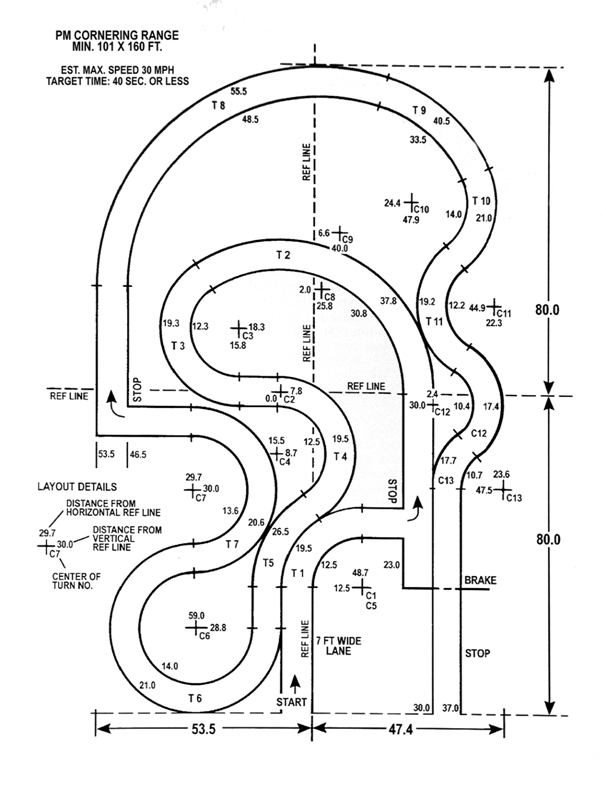
There is a practice cornering range in More Proficient Motorcycling that's been painted down in various locations around the country. The Idaho State Police are using it for officer training. Team Oregon follows the same idea, but they use a go cart track. Personally, I think rally participants would gain skill quickly by riding such a cornering range. Or, perhaps your local club could find some pavement and set it up. There are detailed instructions for laying out and running the PM Cornering Range in the book.
Illustration: The PM Cornering Range
So, what's important? Skills or Knowledge?
The emphasis on "emergency skills" in training courses has led us to believe that control skills are where we should focus. Certainly, it's important to know how to corner, how to shift gears without sliding the rear tire, how to brake hard without falling down. But eventually most of us realize that what's really important is to know what trouble looks like, and how to avoid riding into it.
A young, "bulletproof" rider might have the reflexes to ride dumbly into bad situations and then survive with split second maneuvers. 9 out of 10 they make it. But long-term survival demands that we look farther ahead, spot potential problems early, and just make small adjustments in line or speed to avoid a dangerous situation.
Frankly, if you're still experiencing lots of close calls, you're not using your brain enough. If you don't spot a driver about to turn left until he's smack in front of you, it means you weren't paying enough attention to traffic around you. If you come over a hill and suddenly have to brake hard to avoid a truck backing out of a driveway, that means you were riding too fast for your sight distance at the moment. It's important to spot dynamic patterns that could lead to a collision, and take action soon enough to get out of the way. Veteran riders typically have few close calls because they have developed proficient mental skills.
There are a number of other riding skills books available by well-known motorcycle racers, including Nick Ienatsch, Keith Code, and Reg Pridmore. These "track oriented" books are helpful for fast cornering, but that's also the drawback. They are focused primarily on track skills rather than riding on public roads. Whitehorse Press has reworked the MSF's book, "Motorcycling Excellence" into a second edition that now includes tidbits of advice by various famous road racers plus some traffic scenarios by an author you'll probably recognize. This is a good book to give to any new riders in your circle of friends. It might help them avoid a fatal accident while they're figuring it all out.
Please. Let's get smarter about riding on public roads. Stupid hurts.
Needs a life
Miles to go before I sleep....
Posts: 10623
posted December 27, 2005 10:16 AM
...that's why I only ride 'my ride', which is normally several clicks slowere than the group, no matter whom I'm riding with....and I usually ride with people who are far more experienced, skilled, and ride way more fast than me...its my pace, its my life...I ride to ride another day...
____________ “We sleep safe in our beds because rough men
stand ready in the night to visit violence on those
who would do us harm.”
-George Orwell
Needs a life
Miles to go before I sleep....
Posts: 10623
posted December 27, 2005 01:07 PM
...you could say that I'm a couch potato....I'm not as fast as I used to think I was ____________ “We sleep safe in our beds because rough men
stand ready in the night to visit violence on those
who would do us harm.”
-George Orwell
posted December 27, 2005 01:57 PM
good article, and too true. reminds me that i shoudl take one of those eperienced rider MSF courses as i know i have bad habits and should work on things like braking.
i especially agree with one aspect of the article, which is that emergency maneuver skills are less important than using your brain to not get into those situations in the first place. IME most such situations are easily avoidable, esp those that occurr in an urban environment.
posted December 28, 2005 05:06 AM
Davie is an excellent speaker.
When he gave a too brief talk at SBNW 1 He held Dino and my attention with his interesting insights into riding.
He had the participants do a little "excersise" about proper head postion, it was very revealing to say the least.
I have not bought either of his books, even though I intended to after the short seminar he gave.
Think I will do that now.
posted December 29, 2005 05:21 PM
Edited By: FP 10R on 1 Jan 2006 15:54
Not sure what the requirements to get a License on your side of the World are? but the above article clearly applies overhere as well. While I am not one for more legislation/beaurocracy in our lives I would gladly welcome an overhaul of the requirements in Australia.
It would save, I am sure save many lives if the requirements were more focused on education and skill levels prior to actually getting on the road. Track days and a step system should apply to ensure that at least when you do get on the road you have at least some idea of how it all goes.
Generally if you have even a moderate accident on a bike it is usually major injury or fatal unfortunately, let's not even mention a minimum dress code!
____________
"Life is not a rehearsal so make the most of it" Carefully
posted January 01, 2006 09:44 PM
I couldn't agree more with the above! Motorcycling safely is a skill and an art learned over many years. People just starting out should be aware of the seriousness of operating a two-wheeled motor vehicle. When you've got that covered then that's when the fun starts.
____________
Blank

 HOME
HOME NEW TOPIC
 posted December 27, 2005 09:48 AM


 posted December 27, 2005 10:16 AM


 Edited By:

