 |
 HOME HOME |
ARTICLES |
FORUMS |
COLUMNS |
GALLERY |
STORE |
SPONSORS |
CONTACT US |
BRIDGES
A COMMENTARY BY DOUG MEYERFriday April 2nd, 2010
 The Brits call it an "Off"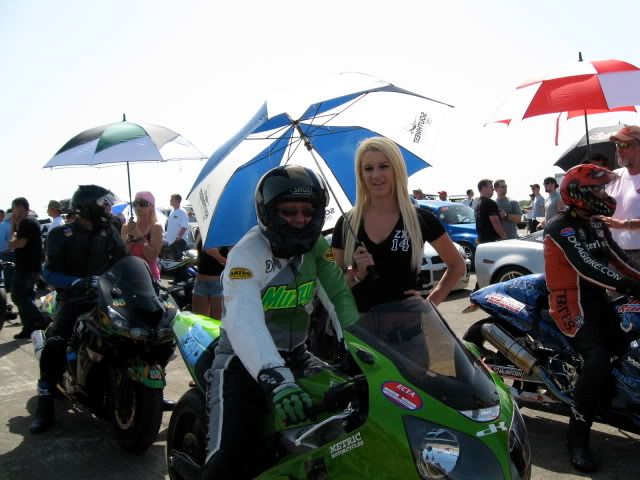
Pretending to be a hero- soon to be humbled.
Karl said to me Saturday morning that Tim Chin had mentioned to him at the Mojave race that he should rebuild his brakes. I squeezed them and agreed. They were kind of mushy and vague, but they worked and I figured he could do it after this meet. Though spongy, there was lever and adequate stopping power so I made a pass and there seemed to be nothing to worry about. Later though, when I went out for another run, I was making a turn while pulling out to get staged and as I reached out with a couple fingers to slow a bit (Karl’s bike does NOT like to go slow), the lever moved too far and then the brakes grabbed hard in the turn, causing me to put a foot down. I definitely did not like the feel of that, so I tried ‘em a couple more times in a straight line pulling up to stage. I clearly was thinking to myself “I don’t like this, I may have some trouble here, I need to be very gentle on the initial pull on the lever, don’t grab a handful, be ready.” Another, more serious little inside voice was saying “Don’t make this pass, go back and bleed the brakes…. It’s not that important…” About then, the starter motioned me forward and I just …went.
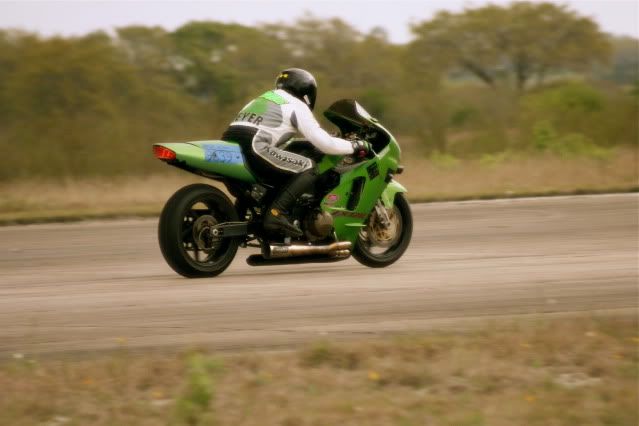
Shouldn't really be here...
This bike is really fun. It pulls hard when spinning the tire just a bit and doesn’t want to stand up. It rips through the gears and puts you hard against the seat. It goes zero to 200 in about 17 seconds, so for about that long I forgot about the brakes. When I saw the mile marker coming I got ready for a less than aggressive grab on the lever. As it flashed by, I pulled a little slower and a little gentler than usual. Nada. I took another pull and got some brakes. This took about three seconds, maybe four. In that time rolling off from 207 mph I may have traveled nearly 1000 feet out of the usual 2500 available. That’s the 1000 feet where I should have knocked off 100 mph, also the 1000 feet between the mile marker and the big dip where the asphalt changes to concrete and where you usually have to get OFF the brakes to avoid locking up the front on the bounce. So now I’m going way too fast way too far along. As soon as I cleared the bump I was pretty much back to normal hard braking, but as I looked at the end of the runway approaching REALLY fast it was quite clear to me that I was going off the end. Looking at a place you don’t want to go, knowing that you ARE going there, traveling triple digits really focuses your attention. I adjusted my trajectory to aim for the narrow white gravel strip on the right side of the grass area. I was braking end-of-the straightaway-with-sticky-race tires-hard. Except, I didn’t have sticky race tires and nice road race suspension. I locked the front on the bumps and it tucked. I got off the lever and recovered it, just like I would have hoped to the rain. I remember thinking (quickly) “I can’t believe I caught that”. I stayed on the brakes as hard as I could for a couple seconds and this is about where I get to the gravel. I think I was going about 50-60 mph. I was running out of pavement four or five seconds too early. The next few seconds were strictly sandy moto-cross. I was standing on the pegs wrestling with the bike through tractor ruts in the soft dirt. I don’t think I ever really stopped. If I had, I would have gotten stuck, so when I got the thing under control I sort of paddled my way around a U turn and headed back out the way I came in. I came face to face with a course marshal in a white Dodge pickup. He was grinning and giving me a thumbs-up. I just nodded because I was afraid to let go of the bars. I didn’t want to finally tip over after all that exciting riding. Back in the pits we looked at the data and, sure enough, I was working the throttle in the dirt.
This could have hurt, but instead what I got was about 15 seconds of the best riding of my life.
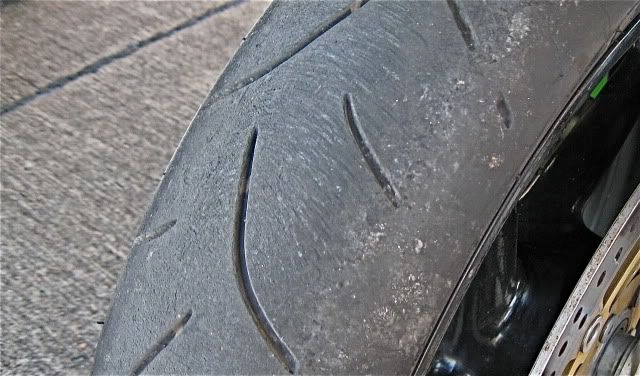
Skid marks ACROSS the tire. Not good!
The whole episode, although exciting, and generating a fun story to tell, makes me feel really stupid. Why? BECAUSE I KNOW BETTER. I knew I should have dealt with the brakes before we raced. I knew I should have turned around in staging, and worst of all, I knew when I left the line that I might very well get my ass handed to me at the other end of that mile.
But I went anyway, with no real reason to have done that.
I’ve learned, or thought I’d learned, over decades of flying airplanes, riding fast bikes and driving fast cars that if it doesn’t look right or feel right, if that little inner voice tells you it just doesn’t seem right, you better LISTEN. Every time. Every time. And never stop riding the bike (or flying the plane) until it's stopped. These reminders are not fun.
Posted by Doug @ 12:58PM - Permalink - 4 Comments - 0 Trackbacks
Monday March 30th, 2009
Makin' Stories......In any endeavor, it's when things go wrong that tests you. LIke the soldier that wants to fight, the racer wants to race, and the builder wants to build- to use his skills to fix what's wrong under the relentless time pressure of a race event .
The totally random and unexpected failure of Karl Gunter's well built engine on his first run at the Texas Mile on Friday gave him and me an opportunity "get in the fight" just to see if we could do it. When Karl said he had parts back in Houston and we looked at each other said "Then let's go fix it! " I couldn't have been more excited. Now we really had a challenge. When we rolled out onto Texas 59 in Karl's ex-cop car white Crown VIc I felt a little like we were Jake and Elwood "on a mission from God".
More than anything, I love assembling engines, and I very much appreciate working with someone else that thinks about it in the same way as I. The silent teamwork that evolves is very satisfying. Probably like a couple of good musicians who've never played together before jamming for the first time. Karl's fitting rings, I'm torquing the cases....four hands silently working to get the cylinder down onto the rings....... ten minutes.... not working... . studs in the way.....not enough chamfer... OK we'll re-split the cases again and put 'em in from the bottom, then the crank after.... no complaints, no drama just another 40 minutes of careful, deliberate work, but when it's done it's done right, with enough confidence that either one of us will get on that bike and pull the 200 mph trigger without a second thought.
Now, don't get me wrong, at 2 AM after 12 hours standing at the bench plus a 3 hour car ride and with another 3 hour Jake and Elwood ahead, I wasn't feeling quite so enamored with the idea, but inside I just couldn't wait to get back to the track. I wanted to get there before anyone else showed up on Saturday, just to really screw with 'em, but the realities of the need for sleep prevailed and we caught a couple of hours. The drive back went quickly not only because Karl was hustling the Vic down the road, but because we were tellin' stories, stories made just this way many times before. I'm very proud to be able to add this one to the book. Running those big numbers was sure awesome but working that hard for it is what really made it great. Thanks to everyone that shows up to race because without each of us and all of us, this wouldn't really be any fun.
Posted by Doug @ 8:36PM - Permalink - 5 Comments - 0 Trackbacks
Tuesday November 11th, 2008
A Veterans Day StoryI made a new friend the other day at my usual morning coffee BS session. This is 4 or 5 guys with too much BS built up who need to unload every morning or so, (you know how it goes). Talk revolves around the usual essential topics-motorcycles, politics, women, airplanes, you all know the routine. One day last week one of the guys, who is a pilot for a major airline and currently on medical leave, brought along his friend, Mike. At one point during the cross talk we learned that Mike was a pilot as well. Mike and his friend were talking about the vagaries of the FAA and their medical criteria to remain active. Mike mentioned a back surgery in his past and I asked about the scenario. He said it was from the last time he ejected from his jet. “Last time?” I queried. “Well yeah, I shot myself down that time”. “How many times were there?” “Three”, he says, “one over North Viet Nam, one nearly over Thailand, and the last one over Nevada. That time I was testing a missile at China Lake and the rocket motor malfunctioned and blew the right wing off my F-18. I went into an inverted flat spin, passed out from G-LOC and finally the plane broke up. I never regained consciousness, but when the nose came off my seat fired and the chute automatically deployed. They say I took one swing under the chute and hit the ground. After an induced coma and lots of surgeries, I woke up months later and thought it was the day of the flight.”
“Holy crap”, I say. “What about the others?” He said nothing specific about the first shoot down, (I guess it was “routine”)but on the second, he related that he had to run through the Thai jungle for nine days to avoid capture. “Jeeze,” I said, “you’re almost as bad a pilot as John McCain!”
“Not really,” Mike says, “I could just run faster”.
Later (today) I was discussing this with another of the guys. I asked if he knew about Mike’s story and he said, “No he’s just a golf buddy. It never came up”.
You just never know when you’re sitting next to an honest to God Hero, do you?
To all these guys and women, from my late Dad, who recorded the Japanese surrender on the Missouri, to Brian’s dad who at 91 is a Pearl Harbor survivor, to Chris’s dad, who was also at Pearl, and to our brothers in Iraq and Afghanistan, to all that have served for us, I say Thank You. We owe you everything.
Posted by Doug @ 9:32AM - Permalink - 0 Comments - 0 Trackbacks
Monday September 24th, 2007
I sold my 1098.... And here's whyThe speed at which my arms no longer need to support my weight is about 85 mph, clearly too fast for a casual ride and impossible to sustain for more than a couple minutes at a time. Given that the mirrors are non functional, a serious ticket is an eventual given. I needed to see my acupuncturist after my first 200 mi. ride, the nerves in my right shoulder were so irritated. At 170 mph, which on the ZX-12 is an exciting brief sprint, over before you know it, just a waypoint on the way to 200mph and almost too simple, the Ducati is a screaming adrenalin producing experience that requires careful inputs, a torso squeezing tuck and a fight against the slipstream.
When riding below 5000 rpm it is a bit of a snatchy, twitchy, frustrating experience that produces the occasional stalled engine when you least expect it. The stock ECU and mufflers required a level of (de)tuning that left me constantly wanting to just scream. A FI system like the one on the 1098 has the ability to deliver flawless part throttle performance, smooth tip-in and instant response. But these characteristics are clearly NOT available to the rider who wishes to retain the stock ECU and mufflers. It took repeated attempts to tune the engine, an updated ECU, and some trickyness with the 02 sensor to bring the engine to what I believe is an acceptable state of low speed smoothness. I know that by replacing the ECU with the "race" unit and adding the Termi's it would have been all good, but I did not believe that I should have to spend the additional $1200 to get it right. I don't blame Ducati, or the dealer, or his able technician for this. It is what it is, given that the physics and chemistry of internal combustion do not necessarily adhere to man's laws regarding low speed emissions. I would not be surprised if the always patient guys at Bend Euro Moto want me to never buy a Ducati again. There may be a bit of an attitude that runs something along the lines of "Hey it's a Ducati, it's perfect, it's mechanical artwork, who are you to say it should run better?" Well, I know how much better it can be, and it frustrated me.
Sorry guys.
Dan Kyle (Dan Kyle Racing in Seaside CA) has sussed out a method of fixing the horribly and consistently loose throttle cables which stem from a poor fitting throttle tube. He adds needle bearings that fit the bar to the throttle tube (a standard deal on AMA Superbikes). He also has figured out a way to adapt a 916 (I think) Power Commander to the O2 sensor-less Ducati race ECU to provide adequate tune-ability.
As I delivered it to the new owner yesterday, at the foot of the craggy mountains just east of Seattle where I suspect the riding will be all that could be desired, I was satisfied that it was almost perfect, and since he intends to install the aforementioned race ECU and Termi's, it soon will be about as perfect as a sport motorcycle can get.
I wish it could have worked out between us, the Ducati and me, but she was just too much of a pain in the ass when we weren't in the groove.
Posted by Doug @ 3:17PM - Permalink - 1 Comments - 0 Trackbacks
Monday February 5th, 2007
Torque - The question you didn't askI was doing a little reading the other night preparing to write this column about the relationship between horsepower and torque and as I looked at a copy of "THE INTERNAL COMBUSTION ENGINE IN THEORY AND PRACTICE" by Charles F. Taylor, I was struck by what little reference there was to the topic of "horsepower". Horsepower, after all, is what we all apparently seek. We all want to know how much we can get, how much the other guy gets, and how can we get more! How can this most scholarly journal of engine design spend so few pages on such an important subject? The answer is that horsepower really isn't what the engine produces. It produces torque. Torque is what you feel. Torque is what turns the wheels. Torque is what lifts the front end in those long wonderful wheelies and torque is what engine builders really want to find when they design, fiddle and adjust. Horsepower is a measure of what you can do with that torque. Horsepower is the result of a calculation that takes the measured torque of an engine multiplied by time. Torque is a measure of force and horsepower is a measure of work. Work is what the force accomplishes as it is applied over time and distance. Torque is, by definition, the product of a force applied in a rotational motion or twisting force. Remember, there need not be motion for a force to exist. A good example of this is the torque exerted when you try and loosen a very tight nut. As you are pulling on the wrench you are exerting a force, but not until the nut moves has this torque resulted in work. If the wrench is one foot long and you are exerting a force of 50 pounds on the end, you are exerting 50 pound/feet of torque on the nut. The distance from the center to the point where the force is applied is called the moment arm. Now, visualize an engine with a flywheel whose diameter is one foot, and on this flywheel you hang a one-pound weight from the circumference of the flywheel. Then we arrange for this engine to make one power producing stroke from this position and when this happens, the engine produces sufficient force to lift this one-pound weight one foot. We would have seen a force of one foot/pound of work done by the crankshaft. But even though this force might have been applied, it was only when the weight moved (an event which took some amount of time) was work performed, and only then was the measure we call "horsepower" created. Horsepower was defined in the 17th century by James Watt (of steam engine fame) as the amount of work that one horse can (theoretically) produce. His definition of one horsepower was and is the amount of power necessary to lift 33,000 pounds one foot in one minute. He apparently observed that a horse could exert a pull of 150 pounds while moving at 2 1/2 miles per hour. This works out to 33,000 foot pounds per minute (550 ft/lb. per second). I don't know how he got the horse to do that, but that's what he decided to call it. In case you're curious, one horsepower is also 745 "Watts" of electrical energy
To determine the measure of horsepower produced by internal combustion engines the standard calculation is Torque x RPM divided by 5252. Torque is the force, RPM is the amount of time spent applying the force (revs PER MINUTE). Measured torque times RPM only gives force applied over time though, not "horsepower". To get horsepower a further calculation is necessary, one that incorporates the distance and the 5252 is the distance factor.
Let's go back to the flywheel. When the flywheel turns, it produces torque through its' entire revolution. Now, order to measure this force we have to have it act on something at some distance (radius) from the center of its rotation (it doesn't matter where). The moment arm is this radius and of course the time is the RPM. So, the work done (horsepower) is the product of the force (foot/lb.) times the distance traveled in one revolution which is the circumference of the circle (whose radius has become the length of the arm), times the number of times per minute this distance is traveled (RPM). This is convenient, because Watt's horsepower was determined to be 33,000 foot-pounds per minute. I hate to do this, but here I have to resort to showing the actual math. I can't think of any other way. It looks like this:
Force X Circumference X RPM
Horsepower= 33,000
You might remember from high school that the circumference of a circle is computed by the formula 2 Pi times the radius. You can then simplify the above by dividing both the top and bottom by 2 Pi (God help me, I've become my eighth grade math teacher!) and because 33,000 divided by 6.2832 = 5252, it then looks like this:
Force X Radius X RPM
Horsepower= 5252
Or: Torque x RPM
5252
At 5252 RPM, this number appears both above and below the dividing line. Because of this, 5252 rpm is where the horsepower and torque curves will always cross. (You have 5252 (rpm) divided by 5252 (foot-pounds per minute) which is a number (5252) divided by itself which equals 1. And since 1 times any number is the same number, at 5252 RPM all you have left is Horsepower = Torque.
That's not very exiting unfortunately, since the answer to the question has less to do with engines than grade school math.
The term brake horsepower or BHP comes from the device that was developed to measure horsepower, the Prony Brake. The Prony brake was predecessor to modern dynamometers that absorbed the power output of an engine and directed that output to a point that it could be measured. A band of friction material was wrapped around the rotating output of an engine. This band was then tightened as the throttle was opened and a specific RPM was maintained. At the point that the throttle was fully open and any further tightening of the band would slow the engine down, maximum power was being developed. The band had a beam attached to it that acted on a scale. The length of the beam was the arm and the scale measured the force. The resulting readout on the scale was the indicated torque. The above described calculations then gave indicated BHP.
If an engine were to run at a constant RPM, and it had been designed to run ONLY at that rpm, to produce it's maximum twisting force (torque) at that rpm, that rpm would then yield the maximum (and only) horsepower of the engine. Spin it faster and the power production would cease, spin it slower and the power would also cease. But, in the real world engines are designed to run through a range of speeds, to accelerate from low speeds to higher speeds.
Because they are designed to operate through a range, they necessarily work better at some central "band" of rpm. This is the region of "best torque" and the highest point is called "peak torque". As the engine is operated at an rpm less or more than it's optimum point of torque production, the horsepower will vary. This is primarily due to changes in "volumetric efficiency" or the tendency for the airflow into the cylinder to vary with RPM and to be best in a particular range. If the torque was constant and the rpm was increased, the horsepower would continue to increase. But there comes a point at which the increase in the rpm can't make up for the decrease in the torque due to the lessening of the engine's efficiency (it's moving away from the point at which it "works" best-peak torque). The point at which this happens is "peak power". Keep increasing the rpm and horsepower falls off because the torque is falling. Remember, the power is the result of torque times the rpm. If there is no torque, all the rpm in the world won't give you any power. This is why one of the most sought after characteristics of an engine is a broad torque curve. More torque kept higher in the rpm range gives more horsepower. So, what we're actually saying when we say an engine has a lot of horsepower is "It produces a lot of torque at a high rpm". The horsepower number is really just a way of quantifying this with one number. Having said all that, I still like the idea of horsepower. We learn from the time we're little- big numbers are better, and as far as I'm concerned, when it comes to horsepower you can never have too big a number. Next column, I'm going to talk about the relationship between stroke length and torque. I bet it is NOT what you think it is.
Posted by Doug @ 1:57PM - Permalink - 4 Comments - 0 Trackbacks
Older Entries
THE AUTHOR

Doug Meyer has been working with race engines professionally and as a hobby for the past 45 years. He has built engines for everything from dragbikes and cars to outboard race boats, from the famous Can-Am sports cars and an F-1 car to motorcycle streamliners. He spent many years as a professional race team member and engine builder. Everything from nitrous to nitro, Doug's had his hands in it. He has set 16 Bonneville speed records...
Click here to continue
Click here to continue
RECENT ENTRIES
- The Brits call it an "Off"
- Makin' Stories......
- A Veterans Day Story
- I sold my 1098.... And here's why
- Torque - The question you didn't ask
ArchiveAll photographs by Doug Meyer unless otherwise noted